His mother knew at two
Brock was two when his mother first said out loud that something was different. A paediatrician said no. A neurologist said no. He was six before anybody wrote it down — and by then four of the most important years of his life had already gone.
Brock, with his parents Brian and NaidonaPennsylvania, United States
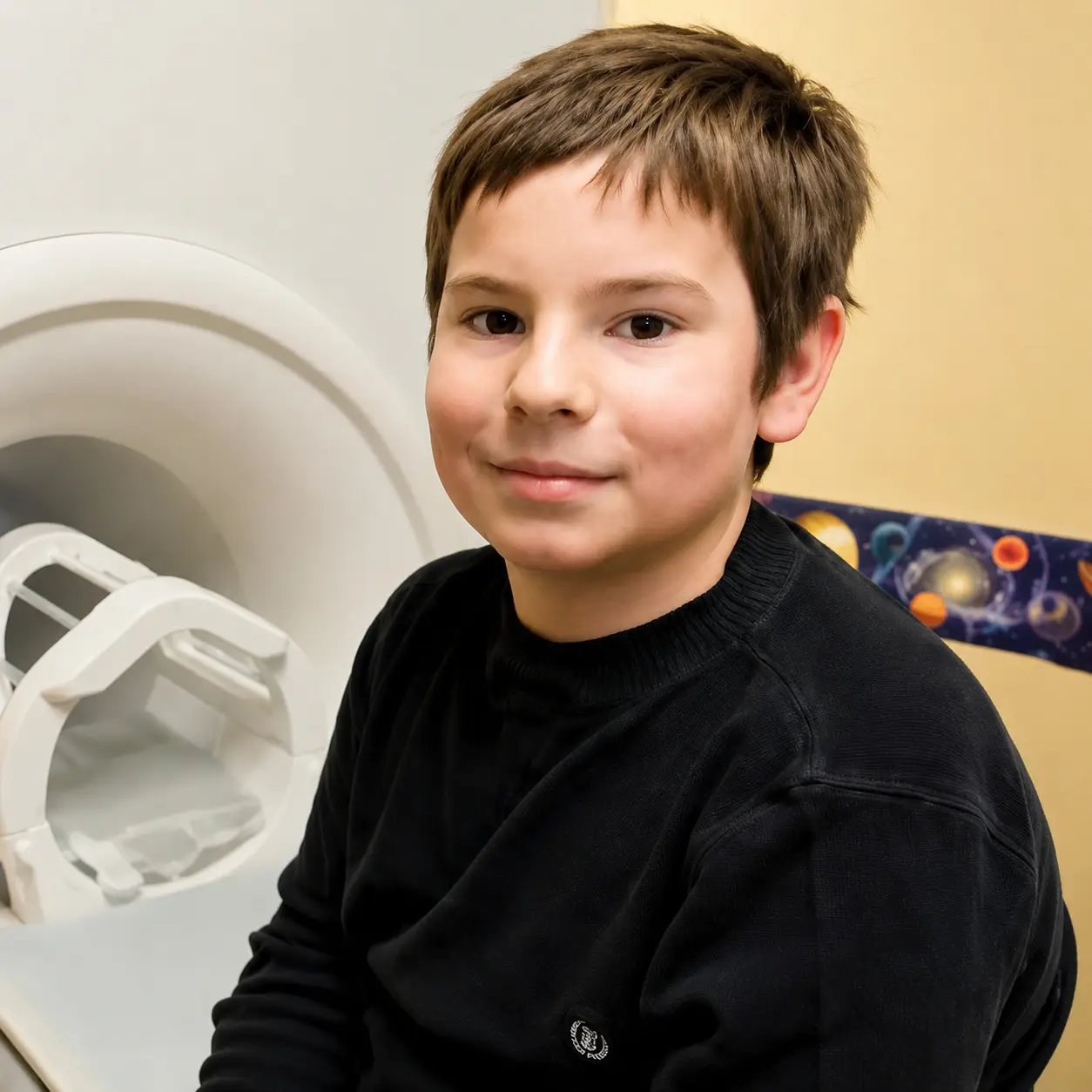
Photograph: Children’s Hospital of Philadelphia
Brock was two years old when his parents noticed that he was not doing what the other two-year-olds were doing. Brian and Naidona had a word for it, privately, between themselves. They took the word to their paediatrician, who told them not to worry. They took it to a neurologist, who told them the same thing.
He was six before anybody agreed with them.
What four years look like from inside a house
At four he had about twenty words. The children he played beside had hundreds; they were, as his parents put it, virtual chatterboxes. He could not reliably remember the names of the people in his own family. He would not meet an eye, and he did not want to be held. Some foods he could not put in his mouth at all, not for the taste but for the feel of them. He spoke in one flat tone. He flicked his fingers. He walked on his toes.
His family gave these things a name of their own — Brockisms — which is what families do when nobody official will give them a name.
None of that was the hard part. The hard part was transitions. Moving him from one activity to the next brought on breakdowns his parents could only describe as catastrophic. A private school took him at four and asked them to take him back mid-year, because a school cannot run on a timetable a child cannot survive.
His mother remembers asking him for a hug. He would give her exactly the number of hugs she had asked for. Not one more, and never unprompted.
You feel horrible for your child because you feel like they’re not happy. You have the guilt that you’re spending all this time on this child who is so difficult. What about the other kids?
— Naidona
We put that line in because it is the one nobody prints. It is not about a diagnosis. It is about what a family becomes while it waits for one.
Then somebody wrote it down
He went into first grade at a public school and was diagnosed there, at six, with autism spectrum disorder. He was put into a classroom built for autistic children, with teaching built for autistic children.
By the end of that year he was back in mainstream lessons for several subjects. The crises had become rare. One later assessment turned up something small and specific — a weakness in working memory that was quietly wrecking his essays — and his teachers simply gave him more scaffolding for writing. Not a cure. A correction, made because somebody had finally looked closely enough to find it.
That is the whole of it. The intervention was not exotic. It was ordinary, it worked, and it was four years late.
Why he is sitting next to a scanner
The photograph on our diary page is Brock at the Center for Autism Research, next to an MRI machine. He volunteered for every study he was eligible for.
One used imaging and infrared eye tracking, and found that unusual connections inside the brain’s limbic system are part of why social relationships are hard. Another had him play games designed to teach a face and a feeling as a matching pair. A third measured his brain’s electrical activity in real time and found something we think about most days: children with autism process sound a fraction of a second slower than other children.
A fraction of a second. Not a behaviour, not a personality, not a parenting failure. A measurable delay in a growing brain — the kind of thing a machine can hear long before a waiting list can.
His father’s explanation for all of it was very simple. Brock’s nature is that he wants to help, so his father encourages it.
He is fine, by the way
He reads the way other people breathe. He composts, he gardens, he films things, he takes technology apart. He intends to build a plant that makes fuel out of algae, and he would like to find something useful to do with discarded cigarette butts. He wants, his father says, to make the world a greener, cleaner place.
His mother’s account of the last few years is the shortest thing in this story and the largest:
I have seen him come so far. Everyone who’s been around him has seen him grow, and they can’t believe the change.
— Naidona
Why this page is in our diary
Because a mother in Feni or Faridpur or Chattogram is saying that same sentence today — something is different — and being told the same thing Naidona was told. Not out of unkindness. Out of arithmetic: Bangladesh has roughly one speech and language therapist for every million people, and almost all of them are in a handful of cities.
Four years is the gap we exist to close. Not with a cleverer expert, but by putting the listening where the child already is — in the house, in Bengali, on an ordinary phone — so that the sentence a mother says at two gets written down at two.
Brock’s story is not ours. It was told by Brian and Naidona to the Children’s Hospital of Philadelphia, and we have only carried it a little further east. We have never met him. Nobody at Stepping treated him, screened him, or had anything to do with his care.
We keep his page here anyway, because of the shape of what he did. A boy who lost four years to being disbelieved grew up and spent his afternoons lying still inside a scanner — so that the delay in his own brain could be measured, written down, and used to find the next child faster.
He wants to spend his life making the world cleaner. He has already spent part of his childhood making it earlier.