Ashraf is sixty-eight, and he still carries Farid
The water came three feet into the house. Ashraf is sixty-eight; Farid is eighteen and cannot walk, or sit, or eat on his own. So his father lifted him up and carried him out through it — the way he has carried him every day for eighteen years.
Farid, 18, and his father AshrafFeni, Bangladesh
Photograph: UNICEF Bangladesh
Farid is eighteen. He has been disabled since the day he was born. He cannot walk, he cannot sit up by himself, and he cannot feed himself.
His father Ashraf is sixty-eight.
That is the whole arithmetic of this story, and everything else in it follows from those two numbers.
The night the water came in
In 2024 the worst floods in three decades came down through eastern Bangladesh. In Feni the water rose three feet inside their house.
Ashraf did the only thing there was to do. He picked his son up in his arms and walked out into it, knee-deep, and kept walking until he reached a shelter.
The shelter was five floors. Every single time Farid needed the toilet, his father carried him down five flights and then carried him back up again. They stayed three or four days, until the water fell.
When they got home, the house had been emptied of everything that made it a house. The stored rice had spoiled. The beds were soaked through with dirty floodwater. The toilet could not be used.
What arrived, and what it was
Then some fairly unglamorous things happened, and we want to be specific about them, because this is what help actually looks like when it works.
Somebody built the family a new toilet.
Somebody laid a concrete path to it, so that the ground between the house and the toilet stopped being an obstacle.
And somebody gave Farid a pair of knee guards, so that he could move himself — his own way, on his own knees — without tearing his skin open doing it.
No app. No algorithm. A toilet, a path, and two pieces of padding. Between them they gave an eighteen-year-old some of his own movement back, and gave a sixty-eight-year-old man a few fewer trips down five flights of stairs.
He likes tea, and he likes music more
It would be easy to leave Farid as the person this happened to. He is not.
He likes tea and biscuits. He likes music considerably more than he likes tea. And he loves the market — not to buy anything, but for the noise of it, and the colours, and the sheer number of people.
Someone has to take him there. That someone is sixty-eight, and he says, plainly, that he cannot carry his son everywhere any more.
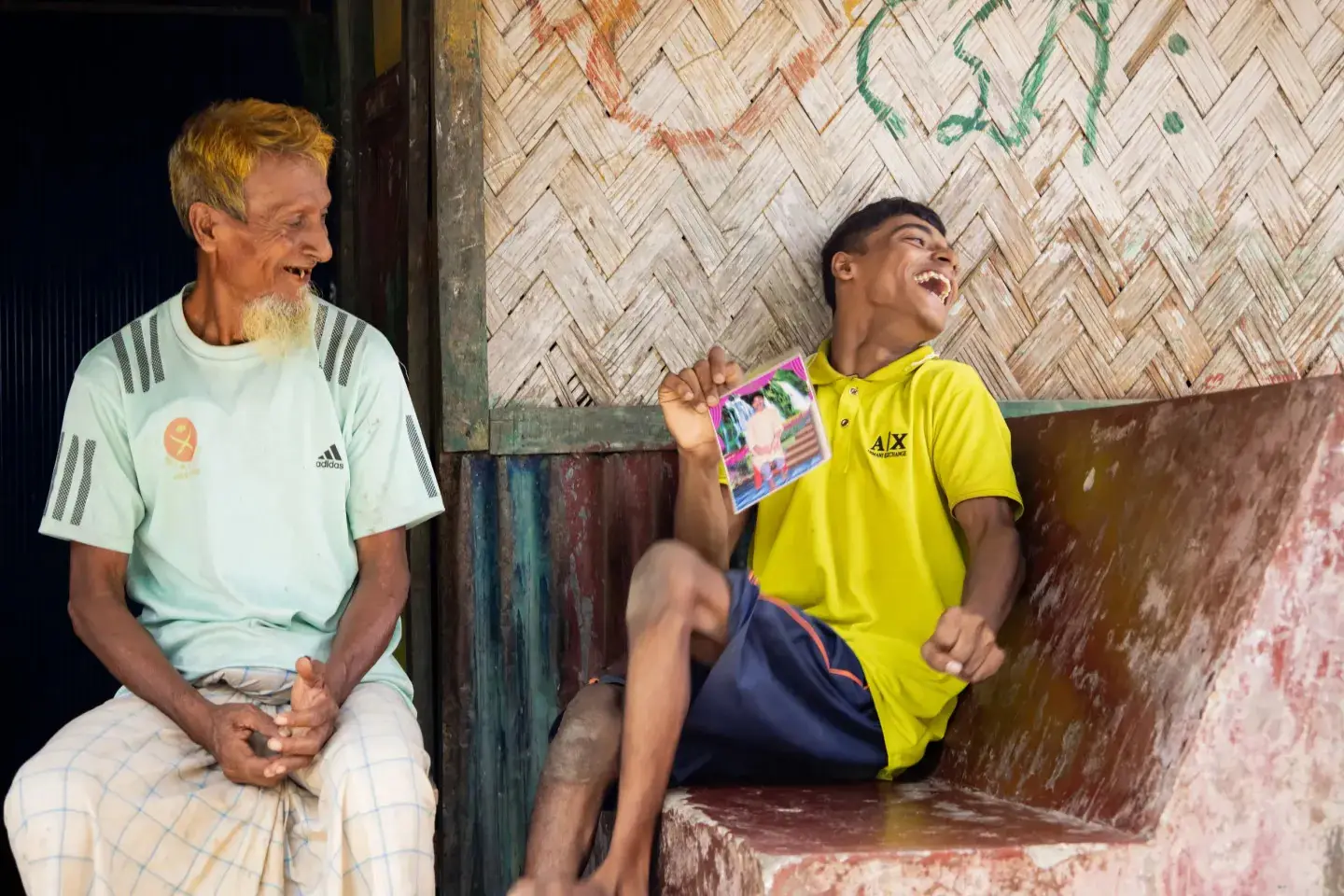
In the photograph on our diary page, Farid has his head tipped back and is laughing at something, holding up a small printed photo so his father can see it. His father is not looking at the picture. He is looking at his son.
Why this page is in our diary
Because Farid is why our vision cannot be an app.
Nobody screened him at two. Nobody wrote a plan for his week. Nobody was measuring his development in the years when the measuring changes things — and now he is eighteen, and the question is no longer how early can we find him but who is going to hold him up when his father cannot.
Both of those are our questions. That is why we are building the thing we are building in the order we are building it: a centre a family can actually reach, therapy that travels to the house instead of demanding the house travel, and support that treats the carer as somebody who also needs holding — not as free labour with no retirement date.
Screening early is how we stop a child from arriving at eighteen unmeasured. Everything else is how we stand behind the ones who already have.
This is Ashraf’s story, and it is not ours to claim. He told it to UNICEF Bangladesh, who photographed him with his son in Feni. Stepping had no part in their care, and no part in the help that reached them. We have written this page because we could not read theirs and then go back to writing about features.
Eighteen years is roughly six and a half thousand days. On every one of them, a man has lifted his son out of bed, and fed him, and put him back.
The floods took the rice, the beds and the toilet. They did not take the one thing in that house that was actually holding it up.
We are trying to build something worthy of standing next to him.